News & Views · Nature Reviews Chemistry
One sequence, different disulfide bridges
A look back at a landmark protein-folding experiment shows how changing the connections within a chain can change its shape.
Source published
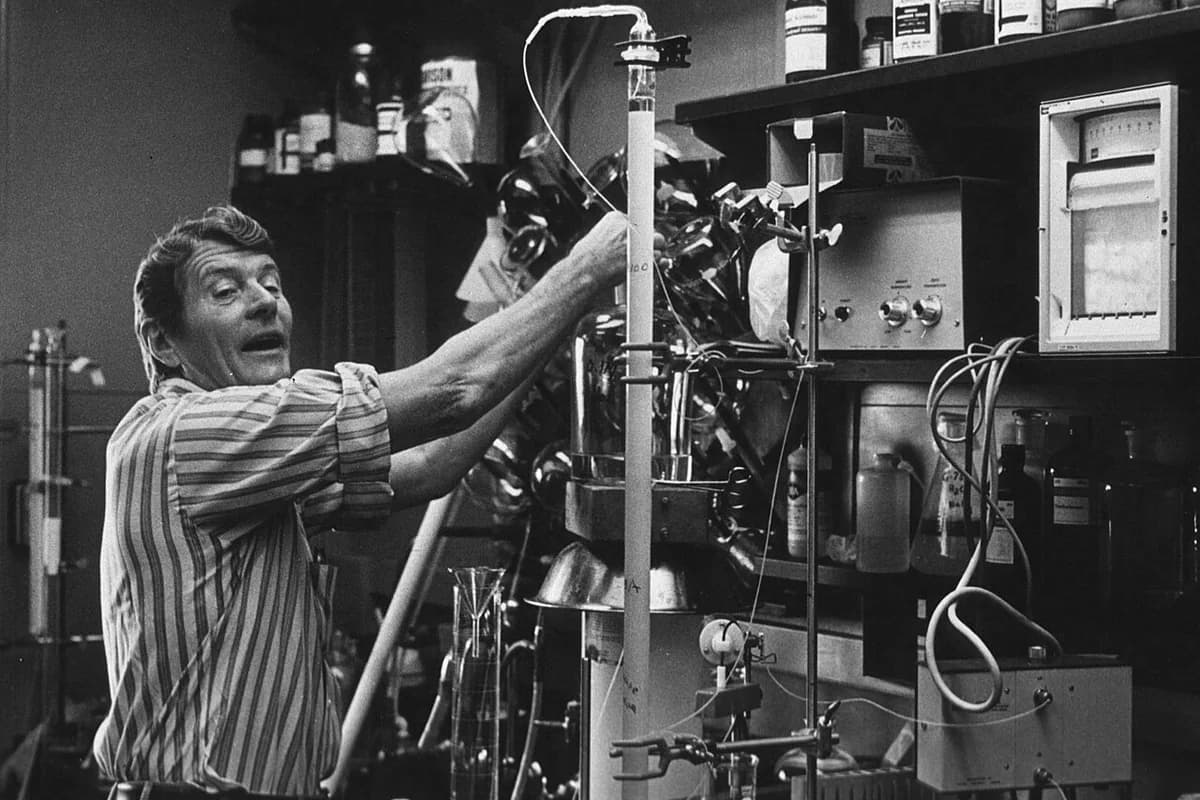
Christian Anfinsen in the laboratory. His work on ribonuclease helped establish the relationship between a protein’s sequence and its folded state.
Credit National Institutes of Health · Public domain · Cropped and converted to WebP


A classic 1961 experiment showed that unfolded ribonuclease could regain its fold and activity. An important part of that story lies in its disulfide bonds, the bridges formed between pairs of cysteine residues.
The same chain offers more than one possible pairing. Choosing which cysteines connect can constrain the molecule into distinct shapes, making connectivity a design choice even when every amino acid stays in the same position.